Plinio Apuleyo Mendoza has died, and with him disappears one of the last witnesses of an irreplaceable generation. Not only because he knew writers, presidents, revolutionaries, painters, journalists and diplomats who shaped the twentieth century, but because he had the rare ability to turn those encounters into written memory.
He was a friend of my father, Pedro Bonett Locarno, and his name also belongs to a close part of my family memory. However, that is where my personal connection ends, because today the protagonist is Plinio Apuleyo Mendoza: the writer, journalist, diplomat and privileged witness.
Pedro Bonett Locarno and the Legal Battle for Bavaria S.A. Read article
Plinio Apuleyo Mendoza lived long enough to witness the birth and collapse of several political certainties. As a young man close to the Latin American left, he experienced from within the enthusiasm sparked by the Cuban Revolution, and ended up becoming one of its harshest critics.
He was also a close friend of Gabriel García Márquez, a companion in travel and hardship in Europe. Over the years, Plinio Apuleyo Mendoza took a deep political distance from García Márquez, but that ideological rupture never erased the affection, the literary admiration, or the shared memory.
Plinio Apuleyo Mendoza died on July 28, 2026 in Colombia, at age 94, after a life devoted to journalism, literature, diplomacy and public debate. Born in Tunja, Boyacá, he studied Political Science in Paris and worked as a writer, diplomat, media director and columnist into old age.
Who was Plinio Apuleyo Mendoza
Answering who Plinio Apuleyo Mendoza was requires looking beyond the list of posts, books and honors. He was, above all, a man placed at the center of his time.
His father, Plinio Mendoza Neira, was a lawyer, a Liberal party leader and a close friend of Jorge Eliécer Gaitán. He was standing beside the leader on April 9, 1948, when Gaitán was assassinated in downtown Bogotá.
The young Plinio Apuleyo Mendoza heard the shots and feared his father had also been killed. That episode was no distant anecdote. It connected him, from a very early age, with Colombian political violence and with a national history that would repeatedly resurface in his articles, novels and memoirs.
He later moved to Europe. Paris was not only where he studied, but the stage where his political formation, his first diplomatic responsibilities and his literary calling intersected.
He served as first secretary of the Colombian Embassy in France and contributed to Colombian and international media. He also served as a Colombian ambassador and took part in major editorial projects.
In 1982, Plinio Apuleyo Mendoza became the first director of the new era of Semana magazine. Although he stayed in the post only a few months, he helped establish the investigative and analytical editorial style with which the publication sought to distinguish itself.
Plinio Apuleyo Mendoza was a storyteller even when writing journalism. His best texts did not seem built to show how much he knew, but to let the reader enter a room, a conversation or an era.
He remembered gestures, tones of voice, broken loyalties and the details others considered secondary. Much of his talent resided there.
Plinio Apuleyo Mendoza and Gabriel García Márquez
The friendship between Plinio Apuleyo Mendoza and Gabriel García Márquez holds a central place in both their lives and their work.
They met as young men and shared years of hardship, travel, political debate and literary projects. Before García Márquez became the author of One Hundred Years of Solitude and received the Nobel Prize in Literature, Plinio Apuleyo Mendoza already knew his obsessions, his family universe and many of the experiences that would later feed his novels.
The two also traveled together through Eastern Europe during the years of their political and intellectual closeness.
From that relationship came El olor de la guayaba (The Fragrance of Guava), published in 1982. The book takes the form of an extensive conversation in which Plinio Apuleyo Mendoza guides Gabriel García Márquez through his childhood, his readings, his working method, the creation of Macondo, politics, fame and the characters who shaped his life.
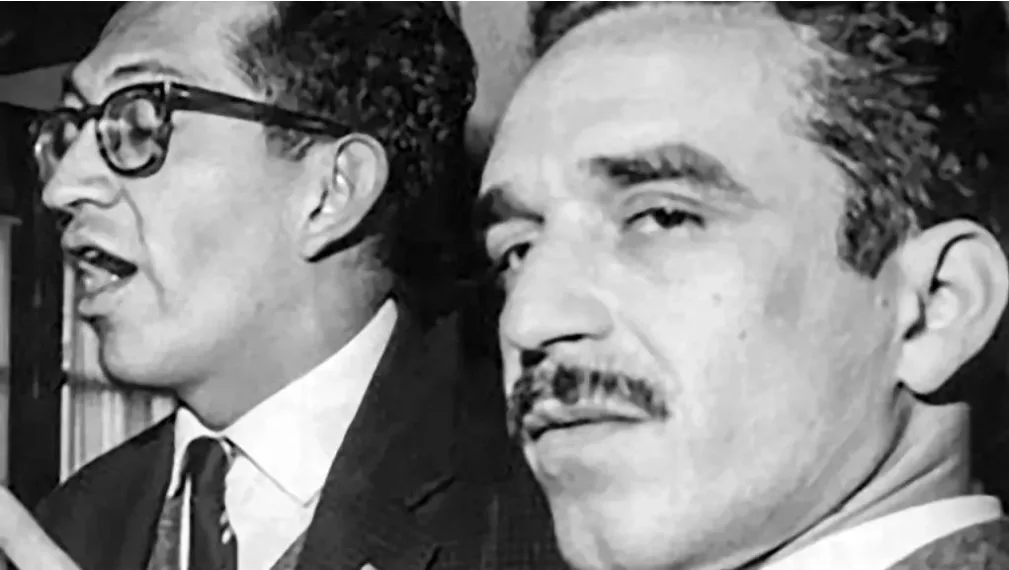
That is why, when someone asks what relationship Plinio Apuleyo Mendoza had with Gabriel García Márquez, the answer does not fit into the word "interviewer." Plinio Apuleyo Mendoza was a friend, an interlocutor, a travel companion and a privileged witness.
He knew what to ask because he knew the story behind the answers.
El olor de la guayaba became a reference work for understanding García Márquez's personal and literary world. It is not a conventional biography nor an ordinary journalistic interview. It is the dialogue between two men who could speak from an intimacy built over decades.
Over the years, the political differences between them grew deep. Plinio Apuleyo Mendoza broke away from the revolutionary left and harshly questioned the Cuban regime. García Márquez maintained his closeness to Fidel Castro.
But even amid that ideological rupture, Plinio Apuleyo Mendoza kept writing about his youthful friend with a mix of admiration, nostalgia and personal knowledge.
In Aquellos tiempos con Gabo, also published under titles such as Gabo: cartas y recuerdos, Plinio Apuleyo Mendoza reconstructed the years they shared, the economic hardships, the writer's formation and the path that led Gabriel García Márquez to worldwide acclaim.
The books of Plinio Apuleyo Mendoza
The books of Plinio Apuleyo Mendoza span the novel, the short story, the chronicle, the political essay, journalism and memoir.
Although Plinio Apuleyo Mendoza's name remained forever linked to Gabriel García Márquez, his literary output followed a path of its own.
Among Plinio Apuleyo Mendoza's most notable books is Años de fuga, the novel for which he won the Plaza y Janés Prize in 1979. The work portrays a Latin American generation shaped by Europe, exile, love, political militancy and a search for identity that always seemed to lie elsewhere.
Decades later, Años de fuga was reissued and reclaimed as one of the central pieces of Plinio Apuleyo Mendoza's fiction.
He also published El desertor, Cinco días en la isla and Entre dos aguas. In the autobiographical and memoir realm came books such as La llama y el hielo, Ráfagas de tiempo, Muchas cosas que contar, Retazos de una vida, El país de mi padre and Postales de una vida.
In those texts, Plinio Apuleyo Mendoza returned often to the people and cities that had shaped his existence.
Paris, Bogotá, Barranquilla, Havana, Caracas, Rome and other places across Latin America and Europe appeared not as points on a map, but as emotional settings. Plinio Apuleyo Mendoza wrote about dead friends, love affairs, political defeats, lost conversations and worlds that stayed alive only because he could still remember them.
Plinio Apuleyo Mendoza and the Manual del perfecto idiota latinoamericano
Another of Plinio Apuleyo Mendoza's most sought-after books is Manual del perfecto idiota latinoamericano ("Guide to the Perfect Latin American Idiot"), written together with Carlos Alberto Montaner and Álvaro Vargas Llosa and published in 1996.
The book was deliberately provocative. Plinio Apuleyo Mendoza, Montaner and Vargas Llosa challenged the political explanations that attributed all of Latin America's problems to imperialism, capitalism or external forces, while minimizing the responsibility of its own governments, leaders and institutions.
For its readers, the Manual del perfecto idiota latinoamericano was a lucid critique of continental left-wing dogmas. For its detractors, it oversimplified complex historical problems and became a tool of ideological confrontation.
The controversy, far from weakening it, kept the title associated with Plinio Apuleyo Mendoza in circulation for decades and led to sequels such as El regreso del idiota and Últimas noticias del nuevo idiota iberoamericano.
The Manual del perfecto idiota latinoamericano also symbolized Plinio Apuleyo Mendoza's political transformation.
He had known the revolutionary illusion up close, but came to believe that many of its promises had led to authoritarianism, poverty and persecution. Plinio Apuleyo Mendoza did not speak like someone observing another's faith from the outside: he wrote from the disenchantment of someone who had once believed.
Plinio Apuleyo Mendoza, journalist, diplomat and polemicist
Plinio Apuleyo Mendoza practiced journalism for much of his life. He wrote profiles, reports, travel chronicles, political analysis and opinion columns.
He also took part in Latin American editorial projects and spent a significant part of his career in the diplomatic service.
Plinio Apuleyo Mendoza was never an indifferent columnist. He took sides, and did so openly. His positions drew both deep support and equally intense rejection.
In his later years, Plinio Apuleyo Mendoza identified with an open defense of liberal democracy and firm opposition to populism, authoritarianism and governments inspired by the Cuban model.
Some of Plinio Apuleyo Mendoza's opinions were harshly disputed. He, too, made no effort to avoid it.
He belonged to a journalistic tradition in which the column was not an exercise in neutrality but a personal intervention in public debate. Vehemence was part of his writing and also of the image he built as an intellectual.
That explains why Plinio Apuleyo Mendoza's death does not only prompt tributes. It also revives discussions about his ideas, his political friendships and the evolution of a man who moved from revolutionary fascination to becoming one of the most visible critics of the Latin American left.
The memory of Plinio Apuleyo Mendoza
In old age, Plinio Apuleyo Mendoza wrote increasingly about the past. He did not seem to do it merely out of nostalgia.
He knew he had seen much of the world around him disappear, and understood that his memories also belonged to Colombia's cultural memory.
In a conversation near his eightieth year, Plinio Apuleyo Mendoza said he did not fear death so much as the loss of memory.
The phrase is especially revealing for a writer whose final work consisted, to a large extent, of rescuing scenes, faces and conversations before they disappeared with him.
Plinio Apuleyo Mendoza outlived many of his contemporaries. He saw Gabriel García Márquez, Carlos Alberto Montaner and Mario Vargas Llosa die. As recently as 2025 he spoke publicly about the latter and recalled the circumstances in which they had met.
Now Plinio Apuleyo Mendoza's death closes another door on that generation.
The legacy of Plinio Apuleyo Mendoza
Plinio Apuleyo Mendoza's legacy cannot be reduced to a single work, to his friendship with Gabriel García Márquez, nor to a single political stance.
What remains are Plinio Apuleyo Mendoza's novels, his memoirs, his columns, his political essays and the privileged testimony he left about García Márquez.
What also remains is the trajectory of an intellectual who changed his mind without pretending he had never thought otherwise.
Plinio Apuleyo Mendoza's writing preserved something scarce in hurried journalism: the sense that behind events there are always human beings, with ambitions, contradictions, affections, loyalties and fears.
Even when he polemicized, Plinio Apuleyo Mendoza wrote from a life actually lived, not from a slogan learned by rote.
The legal legacy of Plinio Apuleyo Mendoza: copyright and intellectual property
The death of Plinio Apuleyo Mendoza, author of a literary and journalistic catalog built over more than six decades, also produces legal consequences in copyright matters.
Plinio Apuleyo Mendoza's novels, memoirs, columns, interviews and essays do not stop being protected or generating rights upon the death of their author. The economic rights may transfer to his heirs or to whoever legitimately holds title, in accordance with the law, the contracts entered into and the applicable inheritance rules.
These rights include, among other powers, authorizing new editions, translations, adaptations, reproductions, digital publications and other forms of economic exploitation of Plinio Apuleyo Mendoza's works.
Colombian law is specific here. Article 21 of Law 23 of 1982 protects economic rights during the author's life and for eighty years after death. For a jointly authored work, the term is counted from the death of the last co-author.
This last rule is especially important for Manual del perfecto idiota latinoamericano, a work written by Plinio Apuleyo Mendoza, Carlos Alberto Montaner and Álvaro Vargas Llosa.
Plinio Apuleyo Mendoza's death does not mean that work has entered the public domain. Being a joint creation, the exploitation of new editions, translations, adaptations or derivative projects must take into account the rights of the co-authors and their respective successors.
Moral rights also require differentiated treatment. Plinio Apuleyo Mendoza's authorship of his works must continue to be recognized, and the integrity of his texts cannot be altered in a way that harms their merit or reputation, under the Colombian copyright regime.
Plinio Apuleyo Mendoza's catalog also raises particular questions: books written with other authors, published conversations with Gabriel García Márquez, memoirs involving third parties, columns previously assigned to media outlets, and publishing contracts entered into in different countries.
Administering Plinio Apuleyo Mendoza's legacy will require identifying, work by work, who holds the rights, which contracts remain in force, what powers were assigned, and what authorizations are needed for new forms of publication.
For that reason, Plinio Apuleyo Mendoza's intellectual estate is not limited to the physical preservation of his books. It also involves the legal management of his economic rights, the defense of his authorship, and the preservation of the integrity of an extensive body of work.
Plinio Apuleyo Mendoza has died at 94
Plinio Apuleyo Mendoza has died at 94. The news marks the disappearance of a Colombian writer, journalist and diplomat, but also of one of the last men able to recount the Latin American twentieth century as a personal memory.
Plinio Apuleyo Mendoza did not merely know history. He walked inside it, argued with its protagonists, and had the discipline to set it down in writing before he left.
His books will let the conversations, the travels, the political disputes and the characters he knew keep circulating after his death.
Plinio Apuleyo Mendoza's legacy will live on in his novels, his memoirs, his columns, and the personal gaze with which he narrated a world that also disappears with him.
Plinio did not merely know history. He walked inside it, argued with its protagonists, and had the discipline to set it down in writing before he left.
Main sources: Colombian and international press coverage and profiles, July 28, 2026.