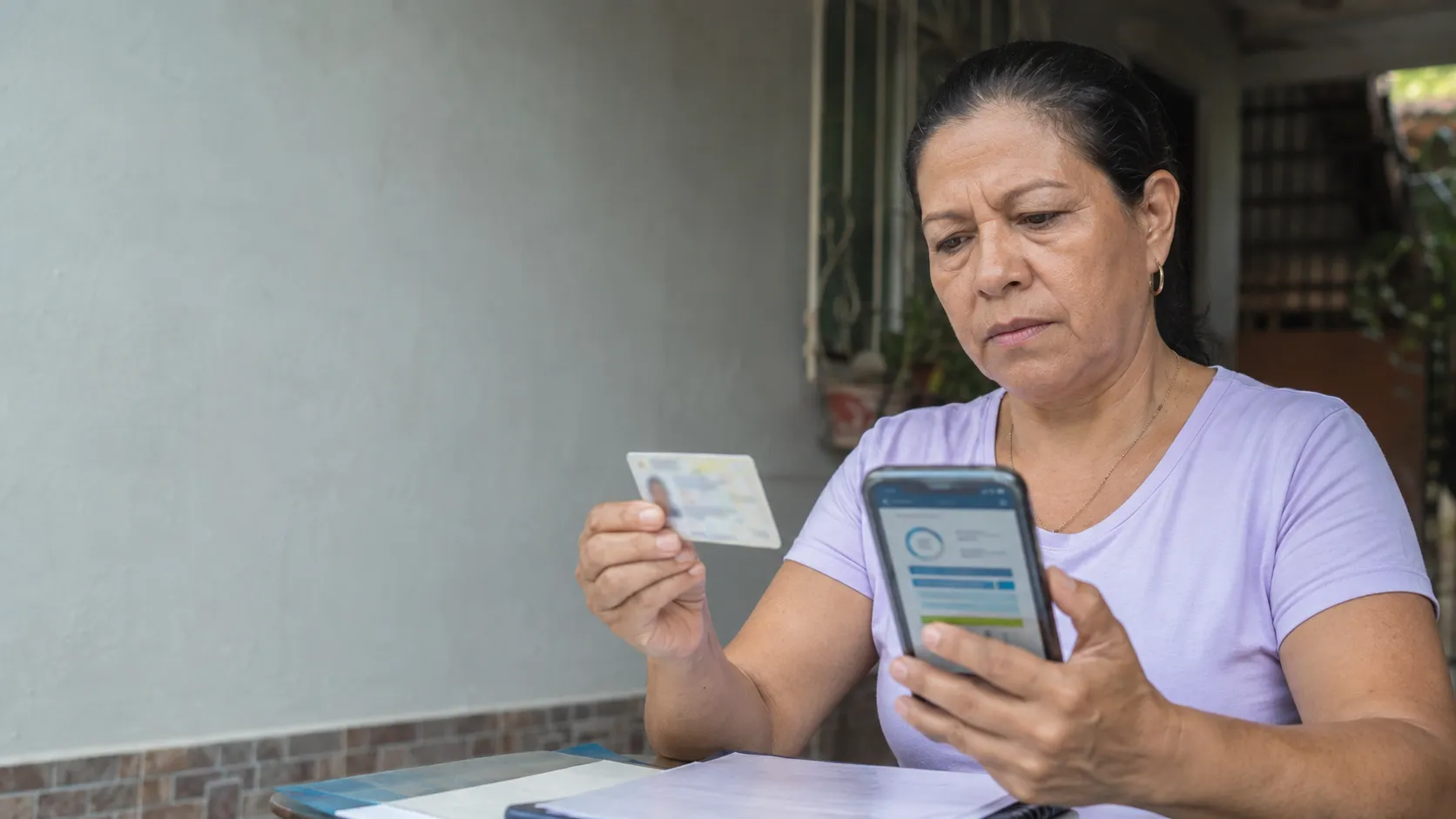
Since early August 2026, thousands of people in Colombia have been trying to run an RUI consultation by ID, log into the National Planning Department's Social Window, and understand whether there is a new score or a new Sisbén classification.
The concern is understandable. The Universal Income Registry, known as the RUI, began to be used as a tool to improve the targeting of subsidies, programs and social services. However, this does not mean that Sisbén has disappeared, nor that a Social Window consultation can automatically withdraw a benefit.
Someone looking to consult the RUI usually wants to know what information appears associated with their ID, how their socioeconomic classification was determined, and what they can do if the income, household members or other data do not match their reality.
An RUI consultation by ID looks like a technology procedure. In reality, it can carry significant legal consequences when the information used by the State influences access to, continuation of, or removal from a social program.
How do you consult the RUI by ID?
The consultation must be done through the National Planning Department's Social Window (Ventanilla Social del DNP). That platform includes the option to consult the Universal Income Registry, where the citizen identifies themselves with their document type and number and completes the required validation steps.
The ID number identifies the holder, but the RUI consultation should not be understood as an open public database. Economic and socioeconomic information is subject to authentication, confidentiality and personal-data-protection rules. A third party should not be able to freely access another person's information simply by typing in their ID.
The RUI consultation is free. No intermediary is required and there is no charge to access the Social Window. If the platform is congested or intermittent, the prudent approach is to verify that the institutional domain is being used and try again later, rather than submitting personal data on unofficial pages.
What is the DNP's Social Window?
The Social Window (Ventanilla Social) is the interaction mechanism between citizens, the socioeconomic information administered by the State, and the institutional offerings available to them.
Through this tool, citizens can run consultations related to the Household Social Registry (Registro Social de Hogares) and the Universal Income Registry. It also serves as a point of guidance for requests to update, review or correct information, according to the powers of the National Planning Department and territorial entities.
For that reason, search terms such as RUI Social Window consultation, DNP Social Window, consult RUI by ID and new Sisbén appear grouped together. Citizens are trying to understand the same institutional change through different names.
What is the Universal Income Registry?
The Universal Income Registry is a tool administered by the National Planning Department to support the targeting of subsidies, services and social programs.
Its purpose is to build a more current approximation of the income and economic conditions of individuals and households by integrating different sources of information.
Unlike a model based exclusively on a survey, the RUI can draw on administrative records from state entities. That is why, upon consulting the RUI, a person may find information built from labor, tax, registry, social security or other official data sources.
Integrating information can improve the identification of households that need support. It can also generate disputes when a source is outdated, contains an error, or does not reflect the citizen's current economic situation.
Does the RUI replace Sisbén?
Sisbén does not disappear. It remains a relevant source within the social information system. The change consists of complementing the data obtained through the survey with administrative records available across different public entities.
That is why searches such as RUI Sisbén consultation, consult Sisbén RUI, new Sisbén, RUI classification or new Sisbén score describe a real concern, even though they do not always use the exact institutional terminology.
The transformation is not simply about replacing one survey with another. It changes how the State gathers, cross-references and analyzes the economic and social information of households.
Is there a new Sisbén score?
The phrase "new Sisbén score" is one of the most common searches among people looking for information about the RUI. However, it can be misleading.
Sisbén IV already used groups and subgroups instead of the old scoring system many people still remember. With the Universal Income Registry, the State strengthens the analysis of income and socioeconomic conditions through administrative records.
That is why, when running an RUI consultation by ID, citizens should not assume they are seeing a new number equivalent to the old Sisbén score.
What matters is establishing which classification appears, which data was used, what period it corresponds to, which entity supplied it, and whether the result has concrete consequences for a social program.
Since when has the RUI been in use?
The Universal Income Registry began operating as a targeting tool on August 1, 2026.
For people already identified through Sisbén before July 31, 2026, a transition period applies. That transition matters because it prevents interpreting the RUI consultation as an immediate replacement of all prior classifications, programs and benefits.
The entities responsible for social program delivery must establish how they will apply the new tool, what transition criteria they will use, and what information and support mechanisms they will offer to citizens.
Does consulting the RUI show whether someone will keep a subsidy?
Not necessarily. The Universal Income Registry functions as an information and targeting tool. It does not, by itself, grant or withdraw all subsidies.
The decision on enrollment, continuation, suspension or removal belongs to the entity responsible for each program, under its own rules, target population, cutoff points and budget availability.
An RUI classification may be relevant to national or territorial programs, but the concrete consequence depends on the regime applicable to each benefit.
Therefore, a person should not conclude they lost a subsidy simply because they found a different classification when consulting the RUI by ID. There must be an action by the competent entity and an explanation of how that information was used.
What information can appear incorrect in an RUI consultation?
Errors can have different origins. There may be labor income the person no longer receives, a terminated employment relationship that still shows as active, a household member who no longer belongs to the household, a property that generates no income, a canceled economic activity, or tax information from a prior period.
There can also be duplications, identification errors, name matches with other people, contradictory records between entities, or delays in updating databases.
When an RUI consultation on the Social Window shows information that does not match reality, it is not enough to simply claim the system made a mistake. It is necessary to identify which data point is incorrect, which source it came from, and what consequence it is producing.
How do you correct wrong RUI data?
The data holder may request access, updating or rectification of their information. The claim should identify the disputed data point, explain what the correct information is, specify why the record is outdated, and provide documents proving the inconsistency.
It is not enough to generally ask that the Sisbén score be changed.
A legally sound request should ask that the data used in the RUI classification be disclosed, along with its source, the period it corresponds to, and its update date. It may also request correction of the record, an explanation of the classification, and notice of the correction to any entities that received the incorrect information.
Where do you challenge an incorrect RUI classification?
The competent authority depends on the origin of the data and the consequence produced. The request may require the intervention of the territorial Social Window, the National Planning Department, the local Sisbén office, the entity that originated the information, or the authority administering the affected subsidy.
If a nonexistent employment relationship appears when consulting the RUI, it may be necessary to first correct the labor or social security record. If the problem relates to household composition, the action may require a territorial update. If an entity has already suspended a benefit, that decision must also be challenged.
In some cases there is no single responsible authority. The problem may involve the entity that produced the data, the one that consolidated the information, and the one that made a decision based on it.
Can a right-of-petition request be filed over RUI errors?
Yes. The right of petition (derecho de petición) can be used to request access to the data, identification of sources, updates, rectification, an explanation of the classification, copies of official actions, and a response from the competent entity.
The petition should make verifiable requests and avoid overly general language.
A useful request can ask that the labor and non-labor income used to determine the classification in the Universal Income Registry be disclosed, that its source, period and update date be identified, and that records not matching the holder's current situation be corrected.
That way, dissatisfaction with the RUI consultation becomes a concrete claim the administration must answer.
Habeas data and the protection of socioeconomic information
The information used by the RUI includes personal, economic and socioeconomic data. The data holder has the right to know their data, request updates, request rectification, dispute inaccurate information, and receive a response to a claim.
The confidentiality applicable to certain technical components cannot become an absolute barrier preventing a citizen from knowing their own information.
The administration may protect technical aspects of the system. What it should not do is impose the consequences of a classification without allowing the affected person to know the specific data used and have a real opportunity to dispute it.
Can the RUI classification change automatically?
Information can be updated as a result of new administrative cross-checks. However, updating a database is one thing, and adopting a decision that affects a subsidy, benefit or individual legal situation is another.
When a classification produces an unfavorable consequence, the responsible entity must be able to explain what changed, why it changed, what the source was, what rule was applied, since when it takes effect, and how it can be challenged.
An administrative decision does not become unquestionable simply because it was generated or supported by a computer system.
Can a subsidy be withdrawn because of a new RUI classification?
There should be no automatic, unexplained withdrawal. The RUI serves as a tool to support targeting, but it is the entities administering each program that must apply their rules and make the corresponding decisions.
If a person loses a benefit, they have the right to know which entity made the decision, what rule was applied, what information was used, and what remedies or claims are available.
The mere appearance of a result on the Social Window does not replace the duty to justify an administrative action.
When can a tutela action be filed?
A tutela (constitutional protection action) can be relevant when an RUI error, an incorrect classification, or an entity's failure to respond threatens fundamental rights.
This can occur when the situation affects a person's minimum living conditions, food, health, the subsistence of an older adult, the rights of children or adolescents, a person with a disability, or a household in extreme vulnerability.
Not every discrepancy with the RUI classification justifies a tutela action. There must be a concrete impact, and it must be explained why ordinary administrative mechanisms do not offer sufficient or timely protection.
What documents can help support a claim?
The usefulness of documents depends on the data point being disputed. Relevant evidence can include labor certifications, proof of contract termination, contribution histories, pay stubs, civil registry records, proof of residence, property certificates, evidence that an asset generates no income, cancellations of business registration, tax returns, or prior responses from public entities.
The claim should show the difference between the information that appears when consulting the RUI and the holder's actual situation.
What to do if the Social Window is not working?
During periods of high demand, access errors, slowness or intermittent outages can occur.
In that case, it is advisable to verify that the institutional site is being used, try again later, keep evidence of the error, and avoid submitting personal information on third-party portals.
When there is an urgency related to the continuity of a subsidy or the protection of minimum living conditions, it may also be necessary to leave a written record with the responsible entity.
A temporary failure of the Social Window does not mean the person is not registered, nor that they have automatically lost a benefit.
Frequently asked questions about the RUI consultation
Can I consult the RUI with only my ID number?
The document type and number identify the citizen, but the platform may require additional validation to protect the holder's information.
Is the RUI consultation free?
Yes. Consulting through the Social Window requires no intermediary and no payment.
Did the RUI eliminate Sisbén?
No. Sisbén remains a relevant source within the social information system.
Does the RUI have a score?
Institutional terminology refers mainly to income information and classification. The phrase "new Sisbén score" is common in searches but may not accurately describe how the RUI works.
Where do I check my RUI classification?
The consultation must be done through the Social Window of Colombia's National Planning Department, using the option for the Universal Income Registry.
What should I do if my classification is wrong?
Identify the incorrect data point, request information on its source, and file a request for update or correction with the competent entity.
Does a different classification automatically remove a subsidy?
No. The entity administering the program must apply its own rules and make the corresponding decision.
Can a tutela be filed?
It may be appropriate when there is a concrete impact on fundamental rights and ordinary mechanisms do not offer sufficient or timely protection.
A technology consultation with legal consequences
An RUI consultation by ID through the Social Window looks, at first glance, like a digital procedure. Behind the result lies an important legal question. The State is integrating information from multiple sources to approximate a person's economic reality.
That model can improve the targeting of social policy, but it also demands controls. Outdated data should not quietly turn into the loss of a subsidy. An automated classification cannot eliminate the right of petition. Technical confidentiality cannot override habeas data. A platform does not replace the duty to justify administrative decisions.
The question is not only how to consult the RUI. The decisive question is what a person can do when the classification tied to their ID does not reflect their true economic situation.
The question is not only how to consult the RUI. The decisive question is what a person can do when the classification tied to their ID does not reflect their true economic situation.
This article is for informational purposes and does not replace the analysis of a specific situation. At Bonett Locarno Pumarejo Abogados we handle claims related to errors in public databases, socioeconomic classification, the right of petition, habeas data, administrative due process and the protection of fundamental rights. When an RUI classification affects a subsidy or an essential household situation, it is necessary to determine which entity produced the data, who made the decision, and what legal mechanism is appropriate to challenge it.